It was a beautiful summer evening, the sun was setting, and the warm breeze was blowing. The perfect night for a drive-in theater.
I had been to drive-in theaters before, but this one was special. It was a great way to spend time with friends, family, or just by yourself.
When we arrived, we were greeted by the friendly ticket booth attendant. He told us which movie was playing and gave us directions to the best spot to park our car. We found the perfect spot and before we knew it, the movie was starting.
The night sky was lit up with the glow of the movie screen. We all sat back in our cars and watched the movie with the windows rolled down. The sound of the movie came through the speakers in our cars and we could feel the bass of the music as it shook our cars.
We all laughed and cheered at the right moments, and when the movie was over, we all felt a little bit closer. Being in the comfort of our own cars made us feel relaxed and comfortable, yet we still had an amazing movie experience.
The night air was filled with laughter and conversation, and we all felt great just being able to spend time together.
The preceding was written by an OpenAI chatbot in response to my prompt to write a story about the fun of a drive-in theater. Looks like pretty soon we bloggers will be out of work.
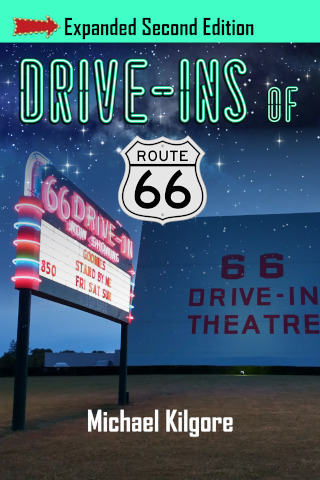
The updated, expanded, sometimes corrected Second Edition of my first book, Drive-Ins of Route 66, is now available from Amazon and your local bookstore (if you ask them to order it for you). Sorry I didn’t mention it earlier, but I’ve had my head down working on my next book.
Years ago, when I wrote the first version of this book, I was rushing to meet deadlines to exhibit it at the Frankfurt Book Fair. I was hoping that someone in Europe would want to publish a translation, the way I hoped that the PowerBall ticket I bought this past Saturday would make me a millionaire. Like that ticket, my German excursion only gave me the fun of taking part in the game.
Even as I was writing that first edition, my approach was evolving. I started with simple, straightforward descriptions of each drive-in with brief notes. As I worked my way west, I told longer anecdotes of the people behind the drive-ins. I carried that idea forward in my second book, Drive-Ins of Colorado, where I tried harder to focus on the owners’ stories. Humans are more interesting than buildings, even screen towers.
Meanwhile, that first book was becoming a little embarrassing. Nobody complained, but I could see a few mistakes. The first whopper was an omission – Marshfield MO was home to the Skyline Drive-In, with an entrance right on US 66. It didn’t last very long and never appeared on any topo maps, but Boxoffice had mentioned Marshfield’s Skyline a couple of times, so I felt bad about its absence. Then I saw that in using an incorrect third-party maps of old Route 66, I had overlooked a bunch of St. Louis-area drive-ins that were close enough to an old Alt-66.
In addition to adding the drive-ins that I’d flat-out missed before, I widened the search to include any within three miles instead of the arbitrary two and a half. I started writing the expanded version without a hard deadline, which was good because the soft deadlines I marked for myself went whizzing by as I kept looking for another photo or a new detail. The result was a book that I’m proud of, 95% rewritten with more drive-ins, more photos, and better stories.
On the other hand, the new book’s only been out a few weeks, yet I’ve already found a few areas that could be improved. I’ve got a new way of covering that – a corrections and updates section on the official book page here on Carload. This will also be a nice way for me to link to some great online photos that I couldn’t add to the book itself.
Anyway, please go buy my book and tell your drive-in-loving friends about it. When my next book comes out, later this year, I’ll tell you more about that one too.
Ad from the Oct. 24, 1953 issue of Motion Picture Herald
This post is going to be too “inside baseball” for just about anyone who doesn’t research the history of drive-in theaters. Anytime you think this is getting dull, feel free to skip to another post. In fact, I’ll bury this a few months back just so normal readers won’t have to put up with it. Since I wish I had read it years ago, I feel compelled to write it to help other researchers; maybe search algorithms will let them find it somehow.
This is a guide to the drive-in theater lists, and a few other parts, of the Motion Picture Almanac* (MPA) series, published by Quigley Publishing Company. The 1947-48 and 1948-49 MPAs each included a simple list of US drive-ins by city. It skipped 1949-50, then the 1950-51 edition launched an annual drive-in list that would continue through 1988. That first full list included each drive-in’s name, city, capacity, and owner.
The name/capacity/owner format continued until the 1967 MPA, when it was compressed to just city, name, and capacity. This reduced version of the list continued until 1977, when it returned to the previous format, complete with owner, and added local addresses. The last change was in the 1983 edition, which replaced the car capacity column with the number of screens.
What’s most important to us researchers when we look at these old lists is how much we can trust their entries. I have no direct knowledge of how they were put together, but I have developed a working theory.
My guess is that the overworked editors, putting together these books in spare hours between issues of their magazine, Motion Picture Herald, added a new entry to the drive-in lists only when they saw a relevant story or got a letter to tell them about it. The MPAs came out early in the year, so if a new drive-in showed up in the 1962 edition, that meant that the letter from its owner probably came in 1961. If no one noticed or cared to write in until later, a drive-in could go years after its opening to show up on the MPA list.
Similarly, once a drive-in was on the list, it would only be edited (new owner or capacity) or deleted if someone wrote in with the news. Although it would be somewhat common for a new owner to ask for the change, most closed drive-ins had no one to let Quigley’s staff know that they should be removed from the list.
In short, the MPA was a lagging indicator. And when it comes to determining what year a drive-in closed, the books are often of little help.
One more, special case: During the decade of reduced MPA drive-in information, 1967-76, even fewer changes than usual made the lists. I call them the “autopilot” years. But in 1977, someone apparently made a special effort to take a new, detailed drive-in census. The 1977 edition was one of the best at describing the theater landscape of its time.
Finally, if you can’t trust the drive-in lists, what can you trust? The answer is the circuit lists. Most of the larger theater ownership circuits had entries in a different annual MPA list. In each of those entries, the circuit would list all of its holdings by state. If the drive-in that you’re checking was owned by one of these circuits, then with a bit of digging, or a digitized search, you can find owner-supplied info that’s more reliable than the MPA drive-in lists.
You read this far? Amazing! Or maybe you’re a kindred spirit, since I was simply writing what I wish someone had told me when I first picked up an MPA just a few years ago.
* In the relevant drive-in list years (1947-1988), the full name for each volume was the International Motion Picture Almanac, except for three editions (1952-53, 1953-54, and 1955) when it became the Motion Picture and Television Almanac.