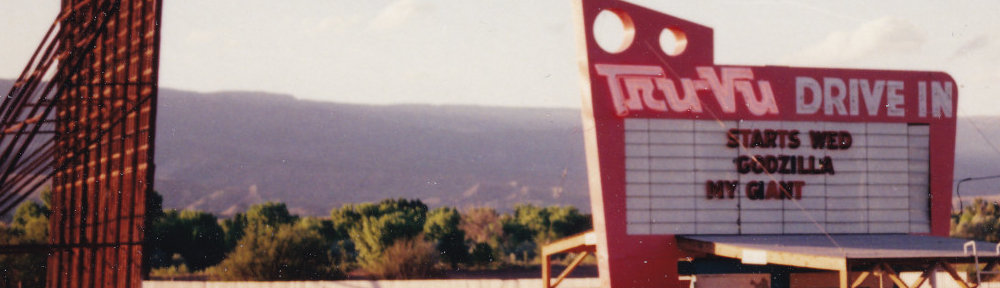
Somerset KY’s 27 Twin Drive-In, open since 1967, won’t reopen for the 2022 season. That was announced on its Facebook page and relayed by WKYT, Lexington’s News Leader.
Owner Brenda Roaden wrote that “the combination of many factors has damaged the viability of the operation.” I don’t know what that means. Could it be that attendance had dropped off?
WKYT reported that Roaden will continue to maintain the grounds, which might lead one to hope that someone new could swoop in to buy the place and get it running again. One Facebook commenter said he expects it to become “a subdivision or strip mall”.
The 27 opened in 1967 with one screen, then added a second in 1980. Let’s hope those screens stay standing, and that someone arrives to light them up again.
Ad from the Oct. 24, 1953 issue of Motion Picture Herald
This post is going to be too “inside baseball” for just about anyone who doesn’t research the history of drive-in theaters. Anytime you think this is getting dull, feel free to skip to another post. In fact, I’ll bury this a few months back just so normal readers won’t have to put up with it. Since I wish I had read it years ago, I feel compelled to write it to help other researchers; maybe search algorithms will let them find it somehow.
This is a guide to the drive-in theater lists, and a few other parts, of the Motion Picture Almanac* (MPA) series, published by Quigley Publishing Company. The 1947-48 and 1948-49 MPAs each included a simple list of US drive-ins by city. It skipped 1949-50, then the 1950-51 edition launched an annual drive-in list that would continue through 1988. That first full list included each drive-in’s name, city, capacity, and owner.
The name/capacity/owner format continued until the 1967 MPA, when it was compressed to just city, name, and capacity. This reduced version of the list continued until 1977, when it returned to the previous format, complete with owner, and added local addresses. The last change was in the 1983 edition, which replaced the car capacity column with the number of screens.
What’s most important to us researchers when we look at these old lists is how much we can trust their entries. I have no direct knowledge of how they were put together, but I have developed a working theory.
My guess is that the overworked editors, putting together these books in spare hours between issues of their magazine, Motion Picture Herald, added a new entry to the drive-in lists only when they saw a relevant story or got a letter to tell them about it. The MPAs came out early in the year, so if a new drive-in showed up in the 1962 edition, that meant that the letter from its owner probably came in 1961. If no one noticed or cared to write in until later, a drive-in could go years after its opening to show up on the MPA list.
Similarly, once a drive-in was on the list, it would only be edited (new owner or capacity) or deleted if someone wrote in with the news. Although it would be somewhat common for a new owner to ask for the change, most closed drive-ins had no one to let Quigley’s staff know that they should be removed from the list.
In short, the MPA was a lagging indicator. And when it comes to determining what year a drive-in closed, the books are often of little help.
One more, special case: During the decade of reduced MPA drive-in information, 1967-76, even fewer changes than usual made the lists. I call them the “autopilot” years. But in 1977, someone apparently made a special effort to take a new, detailed drive-in census. The 1977 edition was one of the best at describing the theater landscape of its time.
Finally, if you can’t trust the drive-in lists, what can you trust? The answer is the circuit lists. Most of the larger theater ownership circuits had entries in a different annual MPA list. In each of those entries, the circuit would list all of its holdings by state. If the drive-in that you’re checking was owned by one of these circuits, then with a bit of digging, or a digitized search, you can find owner-supplied info that’s more reliable than the MPA drive-in lists.
You read this far? Amazing! Or maybe you’re a kindred spirit, since I was simply writing what I wish someone had told me when I first picked up an MPA just a few years ago.
* In the relevant drive-in list years (1947-1988), the full name for each volume was the International Motion Picture Almanac, except for three editions (1952-53, 1953-54, and 1955) when it became the Motion Picture and Television Almanac.
I just posted an index to all of the Boxoffice magazines hosted at Yumpu.com. To start with, it’s only the issues from 1948 through 1965, the era with the most drive-in theater news. Let me tell you why this index is important.
The cover of the Jan. 3, 1948 issue of Boxoffice, available on Yumpu
By the way, hi there! How are you? I’ve been pretty good considering (waving arm at the world). My focus for over a year has been a big project that I’ll talk about very soon, but it’s not this one. Anyway…
Once upon a time, the generous folks at Boxoffice magazine hosted its own archive of back issues, called the Vault, freely available for any internet user to read. (You can see what it used to look like in this Internet Archive capture.) Boxoffice was always the gold standard of movie theater news. It published several regional editions, presumably because a theater owner in Miami didn’t care what was going on in Seattle and vice versa. The gold standard of the gold standard was the National Executive Edition, published for the movie executive who wanted to read about every region’s news. The Vault was full of these NEE versions.
At about the same time, Yumpu also began hosting quite a few of these Boxoffice NEE issues, apparently provided by the same generous magazine workers. Yumpu is an amazing Swiss site with zillions of magazines, but I’ve never been able to find much organization there. Looking for a particular issue feels like rummaging through a deep bin of random magazines at a charity sale, and even Google searches are hit and miss.
About a year ago, the Boxoffice archive went offline. When I asked about it, I got a very friendly reply indicating that the company had an issue with the archive’s host, and it was too busy surviving during the pandemic to spare a lot of resources to restore the archive elsewhere. (I suggested that the Internet Archive would love to share that content with the world, but maybe the company wanted to keep control of its back issues.) Sure enough, as theaters slowly return to full speed, the Vault is still gone.
In the absence of that archive, I turned again to Yumpu’s Boxoffice holdings, of which the University of Pennsylvania’s Online Books Page wrote, “it can be difficult to find a specific issue, and there may be coverage gaps.” So I rolled up my sleeves and began clicking through thousands of issues, storing the link to each one. Some were mislabeled, all were out of order, but none of that mattered. I kept a list by date, adding those links.
The result is an unofficial, probably incomplete index of every Boxoffice issue available on Yumpu. I was surprised at the high percentage that’s available, probably 75% or so if you don’t count 1961, which is completely missing. I compiled the whole thing mainly for myself, because it’s such a great tool for drive-in theater history research, but I’m happy to share it with you. Enjoy!